
Sales Automation
Enterprise Sales Automation
powered by AI.
Discover prospects, engage customers, and automate sales workflows with AI from one enterprise platform.
Plan Mode
Consultative prospect planning.
Discover target companies, identify decision makers, enrich business profiles, uncover buying signals, and build highly qualified prospect lists using natural language.
Plan Mode works like an AI sales consultant. Before a single search runs, it helps you define your ideal customer profile — target industry, geography, company size, buying roles, and the sales strategy you intend to run — so the prospects you get back match the business you actually want to win.
- Company Intelligence
- People Intelligence
- Decision Makers
- Signals
- Revenue Intelligence
Find Mode
Instant prospect discovery.
Search using natural language to instantly discover companies, people, and decision makers that match your ideal customer profile.
Every result arrives enriched — firmographics, roles, and verified contact paths — and exports straight into your CRM, so the list becomes pipeline the same day it is built.
- Natural Language Search
- Company Discovery
- People Discovery
- Contact Enrichment
- CRM Export
AI Sales Agents
AI agents that sell alongside your team.
Deploy AI sales agents to qualify leads, answer questions, automate outreach through WhatsApp, launch broadcast campaigns, run batch outbound calls, schedule meetings, and support sales teams throughout the customer journey.
Agents work every hour of the day in Bahasa Indonesia and English, and hand each warm opportunity to a human seller with the full conversation history attached.
- AI SDR
- WhatsApp Outreach
- Broadcast Campaigns
- Batch Outbound Calls
- Lead Qualification
- Meeting Scheduling
- Customer Engagement
Sales Automation
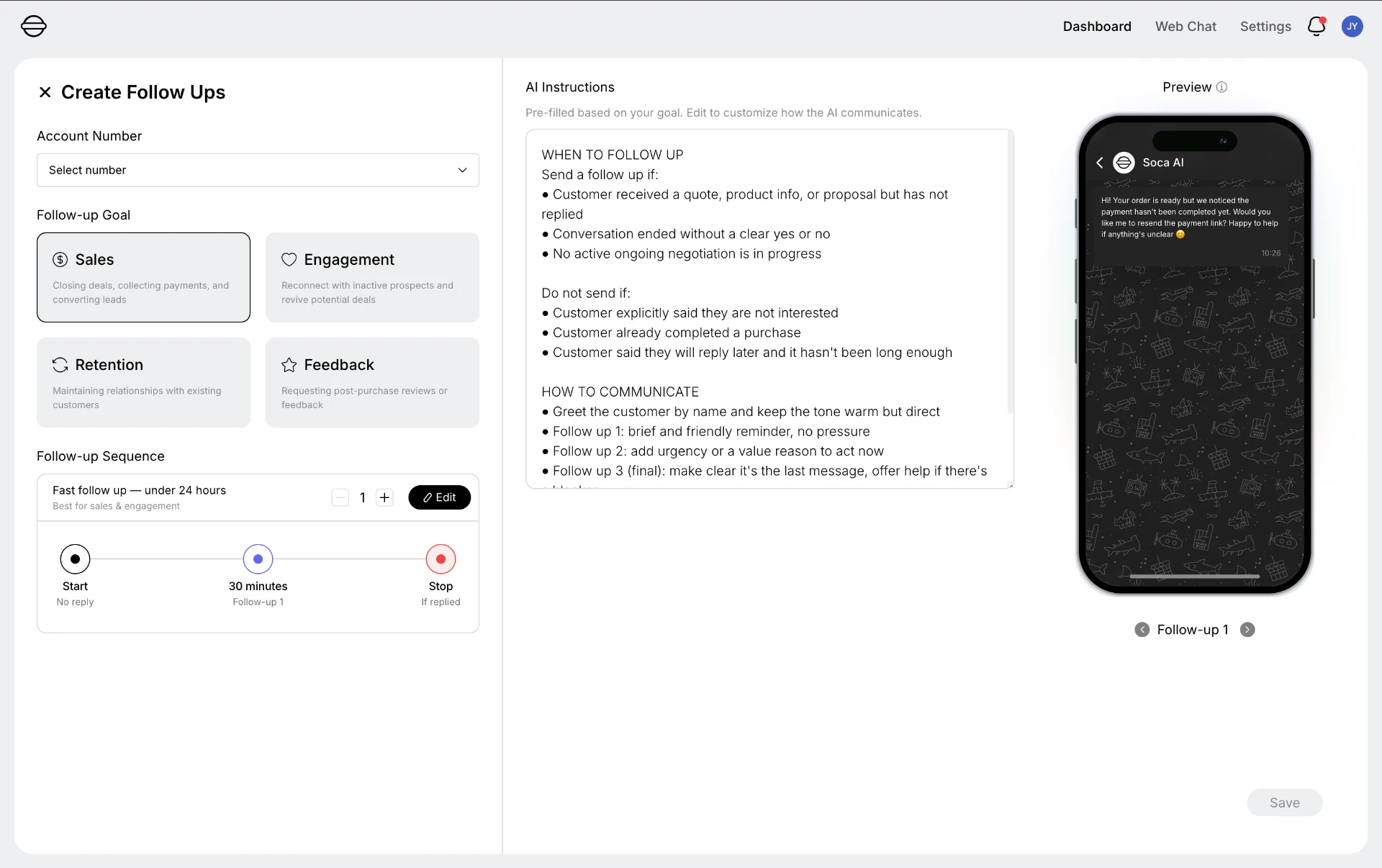
Automated follow-ups that close the loop.
Most deals are lost to silence, not rejection. Automated follow-ups keep every quote, proposal, and unanswered conversation alive — the AI decides when to nudge, what to say, and when to stop the moment a customer replies or converts.
Set a goal — sales, engagement, retention, or feedback — and the sequence builds itself: timed reminders, escalating value messages, and a clear final touch. Everything else connects to CRM, workflows, approvals, and notifications, so records stay current and each lead reaches the right owner in seconds.
- Auto Follow-Ups
- Follow-Up Sequences
- CRM Automation
- Workflow Automation
- Lead Routing
- Approval Flow
Revenue Intelligence
Turn market signals into revenue.
Monitor company growth, hiring activity, expansion, funding, competitor movements, and buying signals to identify high-value opportunities before competitors.
- Buying Signals
- Company Growth
- Market Trends
- Expansion Tracking
Buying signals detected
Last 8 weeks
W8
92 signals · 68 qualified
12,480
Accounts tracked
1,236
Qualified signals
$18.4M
Pipeline influenced
Market coverage
- Jakarta42%
- Surabaya23%
- Bandung16%
- Medan11%
- Makassar8%
Live opportunity feed
PT Nusantara Energi
42 open sales roles
Kirana Logistics
Series B — $38M
Bank Arta Sejahtera
12 cities, Q3
Sentra Manufaktur
ERP migration started
Why sales teams need AI automation
Most sales organizations lose the majority of their selling time before a conversation ever happens. Prospect lists are assembled by hand, contact data ages out, notes live in three systems, and follow-up depends on whoever remembers. The pipeline is not limited by talent — it is limited by manual work.
Traditional tooling made this worse by fragmenting it. A CRM records what already happened, a data vendor sells a static list, and an outreach tool sends the same message to everyone. None of them understand your market, and none of them act.
AI closes the gap. Enterprise sales automation finds the companies that fit your ideal customer profile, identifies the decision makers, watches for the moment an account is ready, opens the conversation, and keeps the CRM accurate — continuously, and at a scale no research team can match.
The outcome is commercial, not technical: more qualified pipeline, shorter cycles, higher seller productivity, and revenue forecasts grounded in real market signals instead of optimism.
Enterprise use cases
Where enterprise sales automation and sales intelligence create measurable revenue impact.
Enterprise Sales
Large sales organizations use AI sales automation to build territory-level prospect lists, route leads, and keep every account moving without manual research.
Business Development
BD teams map new markets, find decision makers at target accounts, and open conversations faster with enriched, verified contact data.
Account-Based Marketing
Build precise account lists from firmographics and buying signals, then coordinate outreach across sales and marketing on the same intelligence.
Channel Partners
Distributors and resellers discover qualified end customers in their region and hand structured pipeline back to the principal.
Market Expansion
Entering a new industry or geography starts with knowing who is there. Sales intelligence maps the market before the first hire.
Investment Research
Corporate development and investment teams track company growth, funding, hiring, and expansion signals across a watchlist.
Powered by Intelligence
One platform behind every revenue motion
Soca Intelligence is the platform powering sales intelligence, AI sales agents, and enterprise sales automation — running on the same data, governance, and deployment model, in the cloud or fully on-premises.
Sales Intelligence
Company, people, and contact data enriched into qualified prospect lists you can act on immediately.
AI Sales Agents
Agents that qualify leads, run WhatsApp outreach and outbound calls, and book meetings for your team.
Enterprise Sales Automation
Workflows, CRM sync, routing, and approvals that remove repetitive work from revenue execution.
Related: Data Intelligence, Voice AI, Enterprise AI in Indonesia, and customer stories.
Sales automation questions, answered
What is Sales Automation?
Sales automation is the use of software to handle the repetitive parts of selling — prospect research, data entry, lead routing, follow-up, reporting, and CRM updates — so sales teams spend their time on conversations and deals instead of admin work.
What is AI Sales Automation?
AI sales automation goes beyond rule-based workflows. Instead of only executing fixed steps, AI understands intent, researches companies and people, writes and personalizes outreach, qualifies inbound leads, and decides the next best action based on real context from your data and the market.
What is Enterprise Sales Automation?
Enterprise sales automation applies the same capability at organizational scale, with governance built in: role-based access, approval flows, audit trails, CRM and ERP integration, and deployment options that satisfy security and data-residency requirements — including on-premises.
What is Sales Intelligence?
Sales intelligence is the data and analysis layer behind good selling: which companies fit your ideal customer profile, who the decision makers are, how to reach them, and what is happening at the account right now — hiring, funding, expansion, or technology change.
What is AI Sales Intelligence?
AI sales intelligence lets teams ask for what they want in plain language — for example, 'manufacturing companies in West Java with more than 500 employees hiring supply-chain roles' — and get an enriched, verified list of companies and decision makers instead of running manual filters.
What are AI Sales Agents?
AI sales agents are autonomous assistants that work alongside your team. They qualify inbound leads, answer product questions, run WhatsApp outreach and broadcast campaigns, place batch outbound calls, schedule meetings, and hand warm opportunities to human sellers with full context.
Sales Automation vs CRM — what is the difference?
A CRM is the system of record: it stores accounts, contacts, and deal stages. Sales automation is the system of action: it finds the prospects, enriches the records, executes the outreach, and updates the CRM. They work together — automation supplies the pipeline and keeps the CRM current.
Sales Intelligence vs CRM — what is the difference?
A CRM only knows what your team has already entered. Sales intelligence brings in the outside world: companies you have never contacted, decision makers you have not mapped, and market signals that indicate when an account is ready to buy.
How does AI qualify leads?
AI scores each lead against your ideal customer profile using firmographics, role seniority, engagement, and buying signals, then asks qualifying questions in conversation where needed. Leads that meet your criteria are routed to sellers; the rest stay in automated nurture.
Can Sales Automation integrate with our CRM?
Yes. Prospects, enriched contacts, activity, and agent conversations sync into your existing CRM, and workflows can be triggered from CRM events so your team keeps working in the tools they already use.
Is Sales Automation available on-premises?
Yes. Soca AI runs in the cloud, in a private cloud, or fully on-premises on the Genesist platform, so regulated organizations can automate sales while keeping customer data inside their own infrastructure.
Is Sales Automation available in Indonesia?
Yes. Soca AI is an Indonesian enterprise AI company, and sales automation in Indonesia is a core focus: local company and contact coverage, Bahasa Indonesia conversations, WhatsApp as a primary channel, and deployment inside Indonesian data centers.
What industries benefit from Sales Automation?
Any industry with a considered sales cycle — technology, manufacturing, financial services, telecommunications, logistics, energy, healthcare, and professional services — benefits most, because research and follow-up consume a large share of seller time.
How quickly can a sales team see results?
Prospect discovery and enrichment deliver value on day one, since lists that took analysts days are produced in minutes. Agent-led outreach and CRM automation typically show measurable pipeline impact within the first few weeks of rollout.
Does AI replace sales representatives?
No. AI removes research, data entry, and first-touch follow-up so representatives spend their time on qualified conversations, negotiation, and relationships. The team stays; the manual work goes.
Ready to automate your sales pipeline?
Accelerate revenue growth with AI-powered Sales Intelligence, AI Sales Agents, and Enterprise Sales Automation.