
Company · Nov 21, 2026 · 4 min read
Why So Many Enterprise AI Pilots Never Reach Production
By Soca AI

Almost every organization in Indonesia is now investing in AI, yet only a few are seeing real results. That is the starting point of PUSAKA AI Investment Brief 2027, Soca AI's latest research report, built on our experience working with government institutions, state-owned enterprises (BUMN), banks, and private companies.
One of the sharpest findings in the report: many enterprise AI initiatives do not fail because of the technology. They fail because nobody is in control. PUSAKA calls it the "Co-Pilot, No Captain" syndrome.
"AI has moved past the hype phase. Almost every organization is now investing, yet only a few truly see the results. Our experience at Soca AI working with many institutions and organizations shows that AI success is rarely determined by the technology, but by the quality of the decisions behind it."
Jimmy Yo, Founder & CEO, Soca AI
Stuck in pilot purgatory
Pilot purgatory is what happens when an AI pilot keeps getting extended, repeated, or left running without anyone deciding to move it into production or shut it down. Globally, Gartner estimated that at least 30% of generative AI projects would be abandoned after proof of concept by the end of 2025.
In Indonesia, the symptom shows up in maturity. On the AI Maturity Spectrum defined in PUSAKA (Explore, Apply, Integrate, Transform), most Indonesian enterprises are still at the Apply stage: AI is in use, but limited to specific functions and not yet part of decision-making or the business model.
Five signs of a pilot without a "captain"
- No business owner. The pilot is initiated by IT or a vendor, while the user division is only a participant.
- No executive sponsor. Without leadership support, the pilot struggles to secure follow-on budget, cross-division data access, or decisions to change workflows.
- No success criteria. Without agreed targets, there is no basis for judging whether the results are worth scaling.
- No post-pilot plan. Budget, infrastructure, and a production team are not prepared, so even a successful pilot goes nowhere.
- The goal is not solving a problem. The pilot exists to absorb budget, hit an innovation target, or follow a trend.
The report also highlights what Indonesian practitioners call "ngamen use case": IT teams going from division to division looking for problems AI could solve. Add FOMO from use cases trending on social media, and many pilots are born from hype rather than real needs.
Captain and crew: the role of an AI task force
According to PUSAKA, a real captain is not just someone who signs off, but someone who can assemble and lead a crew. In Indonesia, that crew usually takes the form of a cross-functional task force (Satgas), with C-level executives acting as the Steering Committee. In Soca AI's experience, this structure has so far only been seen at BUMN level, not yet in government or the private sector.
The ideal structure involves six roles: Steering Committee, task force, business owner, users, data owner, and technical team. The data owner is often not the user division, and without their involvement, data access and quality become the main blocker.
Turbulence on the way to production
Pilots usually run on limited data, selected users, and a controlled scope. Real complexity only appears when the solution has to serve the whole organization. PUSAKA identifies five common sources of turbulence:
- Data readiness: production data is scattered across systems, incomplete, and inconsistent.
- Legacy system integration: ERP, core banking, or internal applications, often more complex, slower, and more expensive than building the AI itself.
- User readiness and work culture: a technically successful solution is not necessarily a used one.
- Governance and security: including compliance with Indonesia's Personal Data Protection Law (UU PDP) and accountability for AI-based decisions.
- Impact measurement: without clear metrics, budget to scale is hard to secure, even when the pilot is considered a success.
In large enterprises, the legacy systems involved can number in the dozens, managed by many different vendors. That is why the license price is only part of the total cost. Frequently overlooked components include data preparation, legacy integration, infrastructure, security and compliance, and training and change management.
Beware the Q4 "ghost budget"
Year-end momentum amplifies the risk. Unabsorbed funds, or money that suddenly becomes available without planning, push rushed purchases with near-impossible implementation deadlines while users are not ready. PUSAKA calls this the "ghost budget" (anggaran hantu), and such investments risk ending up as unused systems.
The recommendation: put AI initiatives into planning documents early (Renstra and RKA-K/L in government, RKAP in BUMN, or the budget cycle in private companies), and use leftover budget for supporting needs such as training or data preparation instead of forcing an implementation that is not ready.
First step: appoint a captain before the pilot starts
For user organizations, PUSAKA recommends three things before any trial begins: form a task force with an official mandate, involve data owners from day one, and agree on success criteria and a post-pilot plan. For technology providers, make sure the client has a sponsor, a business owner, and access to data owners before committing to a pilot.
Read the full report
PUSAKA AI Investment Brief 2027 goes deeper into budget cycles across government, BUMN, and private companies, investment priorities by business function, a readiness checklist from pilot to production (The Flight Plan), Build, Buy, or Partner choices, and The 2027 Playbook.
More articles
Company · Aug 4, 2026
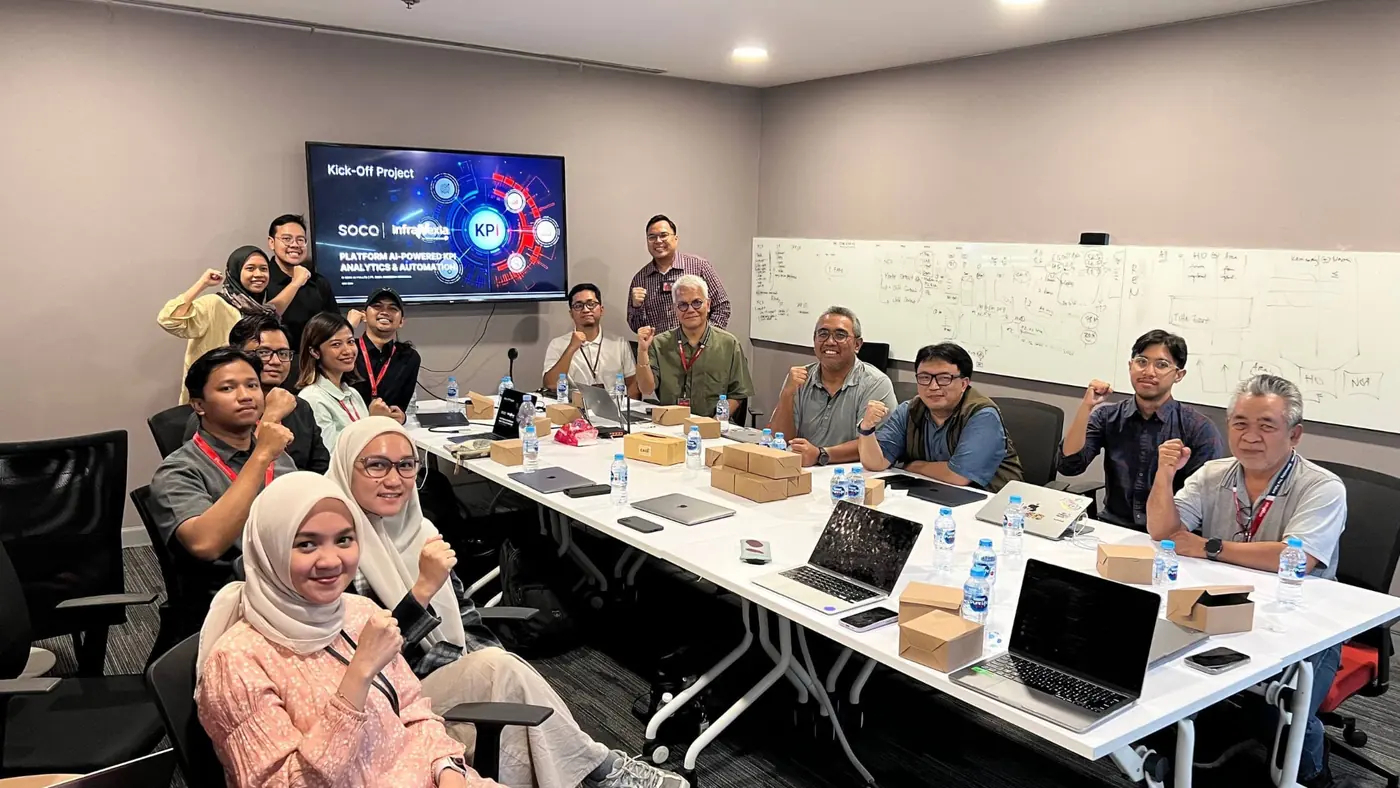
Kick Off AI Project for Infranexia
Soca AI is deploying an AI-powered KPI analytics and automation solution for Infranexia to transform performance management for over 100 strategic KPIs.
2 min read

Company · Apr 28, 2026
Best B2B Lead Generation & Sales Automation Platform in Indonesia
Discover how AI helps companies find B2B leads with greater precision and automate the sales process from outreach to prospect qualification. Learn how Soca AI helps sales teams save time and increase sales process efficiency.
2 min read

Company · Apr 27, 2026
Enterprise AI On-Premise for Business Data Security
Learn how Enterprise AI On-Premise helps enterprises maintain data security, mitigate the risk of information leaks, and build more secure AI systems in Indonesia's business environment.
3 min read