
Company · Apr 14, 2026 · 3 min read
How to Measure the ROI of Enterprise AI Implementation
By Soca AI

Many Indonesian companies have started implementing AI. However, when asked one simple question — "How significant is its impact on the business?" — most do not yet have a clear answer.
This is not because the AI is not working. Rather, it is because there is no framework in place to measure it.
This article is here to fill that gap: a practical guide to measuring the ROI of AI implementation, tailored for decision-makers in Indonesian enterprises.
Why Is AI ROI Hard to Measure?
Unlike traditional investments where results can be calculated directly — purchasing a machine increases production by a certain percentage — the impact of AI is often indirect: time efficiency, improved decision quality, reduced human error, or increased customer satisfaction.
The three most common obstacles encountered are:
Lack of a clear baseline: Before implementing AI, many companies fail to document their baseline operational conditions. Consequently, there is no benchmark figure to determine the extent of the change that has occurred.
Measuring short-term impact only: AI often delivers an impact that only becomes truly significant after 3–6 months. Companies that measure ROI too early tend to get figures that are not yet representative.
Failing to isolate AI's impact from other factors: Sales increased after implementing AI — but was it due to the AI, a more experienced sales team, or improving market conditions? Without proper variable isolation, the results will be biased.
AI ROI Measurement Framework: 4 Key Dimensions
Time Efficiency (Time Saved)
Calculate how many hours per week have been saved from previously manual processes.
A simple formula:
(Working hours before AI − Working hours after AI) × Average employee hourly cost × 52 weeks
Example: If AI automation saves 5 hours/week per employee across 10 relevant employees, with an average hourly cost of IDR 100,000 — the annual savings reach IDR 260 million.
Revenue Increase (Revenue Impact)
Specifically for AI that directly touches sales or customer engagement processes, measure:
Number of leads successfully converted before vs. after AI
Average closing time before vs. after AI
Average transaction value generated from the AI-managed pipeline
Operational Cost Reduction
AI that automates specific processes directly reduces costs. Measure the difference in operational expenses before and after implementation, including:
Recruitment costs for roles that are now automated
Costs associated with human error that are now reduced
Overtime expenses that have been eliminated
Quality Impact
This is often overlooked, yet it is crucial for the long term: to what extent does AI improve output quality? Measure this using metrics such as:
Customer satisfaction score (CSAT) before vs. after
Error rate in automated processes
Customer Net Promoter Score (NPS)
Case Study: B2B Sales WhatsApp Automation
A B2B distribution company implemented AI to automate WhatsApp follow-ups for 500 active leads per month. Previously, this process was handled by 2 sales reps who spent an average of 4 hours per day solely sending messages and following up manually.
Before AI:
2 sales reps × 4 hours/day × 22 working days = 176 hours/month for follow-ups
Conversion rate: 8%
Average deal value: IDR 15 million
After AI:
Follow-up time: nearly 0 hours (fully automated)
Conversion rate increased to 13% due to more consistent and timely follow-ups
The 2 sales reps could focus on closing and relationship building
Results in 3 months:
Time savings: ~528 hours redirected to higher-value activities
Revenue increase: 5% additional conversion × 500 leads × IDR 15 million = IDR 375 million additional revenue per month
When Should You Start Measuring?
Ideally, ROI measurement should be conducted across three phases:
Pre-implementation: Before go-live, measuring the baseline for all key metrics
Early tracking: Weeks 1–4, measuring adoption rate and initial efficiencies
Full measurement: Months 3–6, measuring comprehensive ROI across all dimensions
Measuring AI ROI is not about finding numbers that look good on a report — it is about ensuring that the investment made is truly working and can be justified for further scaling.
Companies with a clear measurement framework from the outset will find it much easier to make decisions: whether to scale up, make adjustments, or expand into new use cases.
And that is the difference between companies that merely use AI — and companies that truly manage AI as a business asset.
More articles
Company · Aug 4, 2026
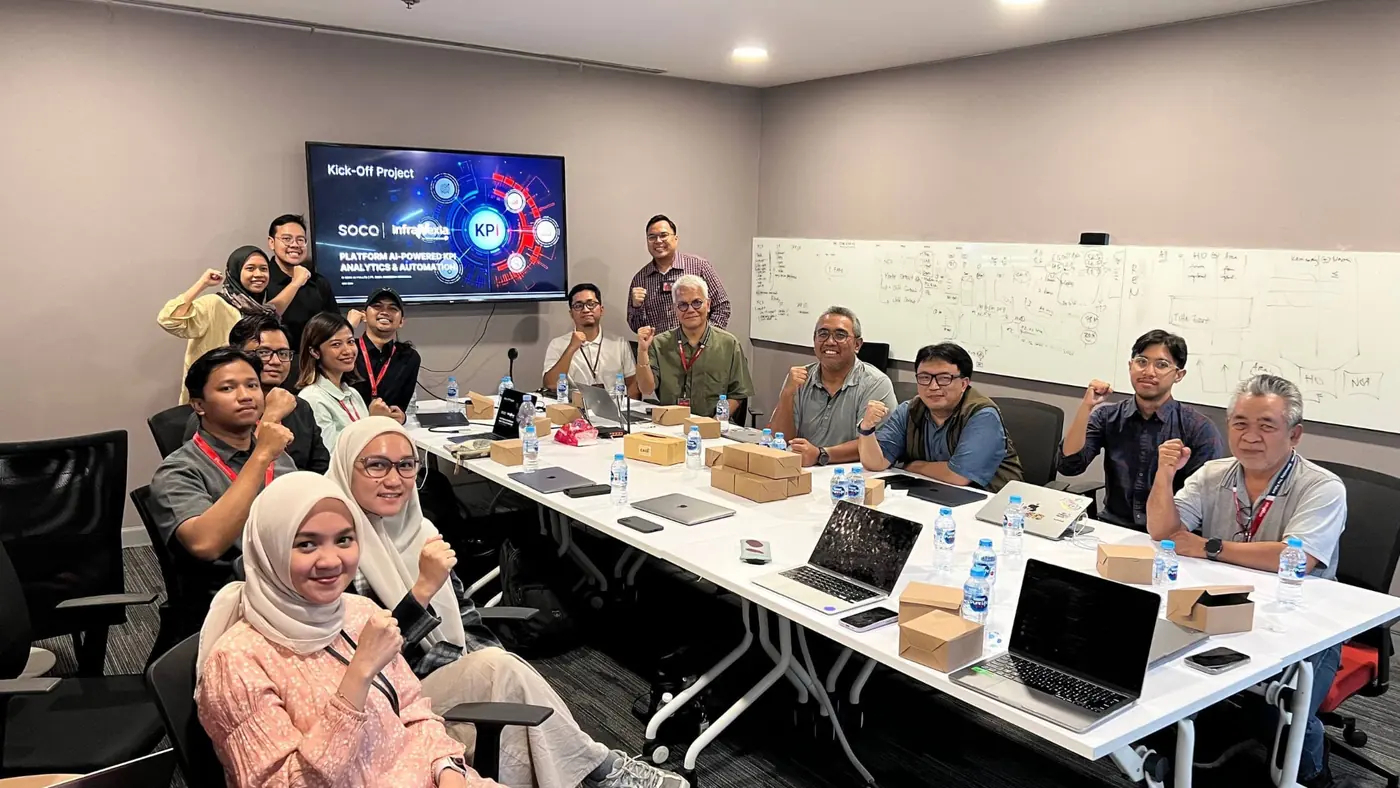
Kick Off AI Project for Infranexia
Soca AI is deploying an AI-powered KPI analytics and automation solution for Infranexia to transform performance management for over 100 strategic KPIs.
2 min read

Company · Apr 28, 2026
Best B2B Lead Generation & Sales Automation Platform in Indonesia
Discover how AI helps companies find B2B leads with greater precision and automate the sales process from outreach to prospect qualification. Learn how Soca AI helps sales teams save time and increase sales process efficiency.
2 min read

Company · Apr 27, 2026
Enterprise AI On-Premise for Business Data Security
Learn how Enterprise AI On-Premise helps enterprises maintain data security, mitigate the risk of information leaks, and build more secure AI systems in Indonesia's business environment.
3 min read